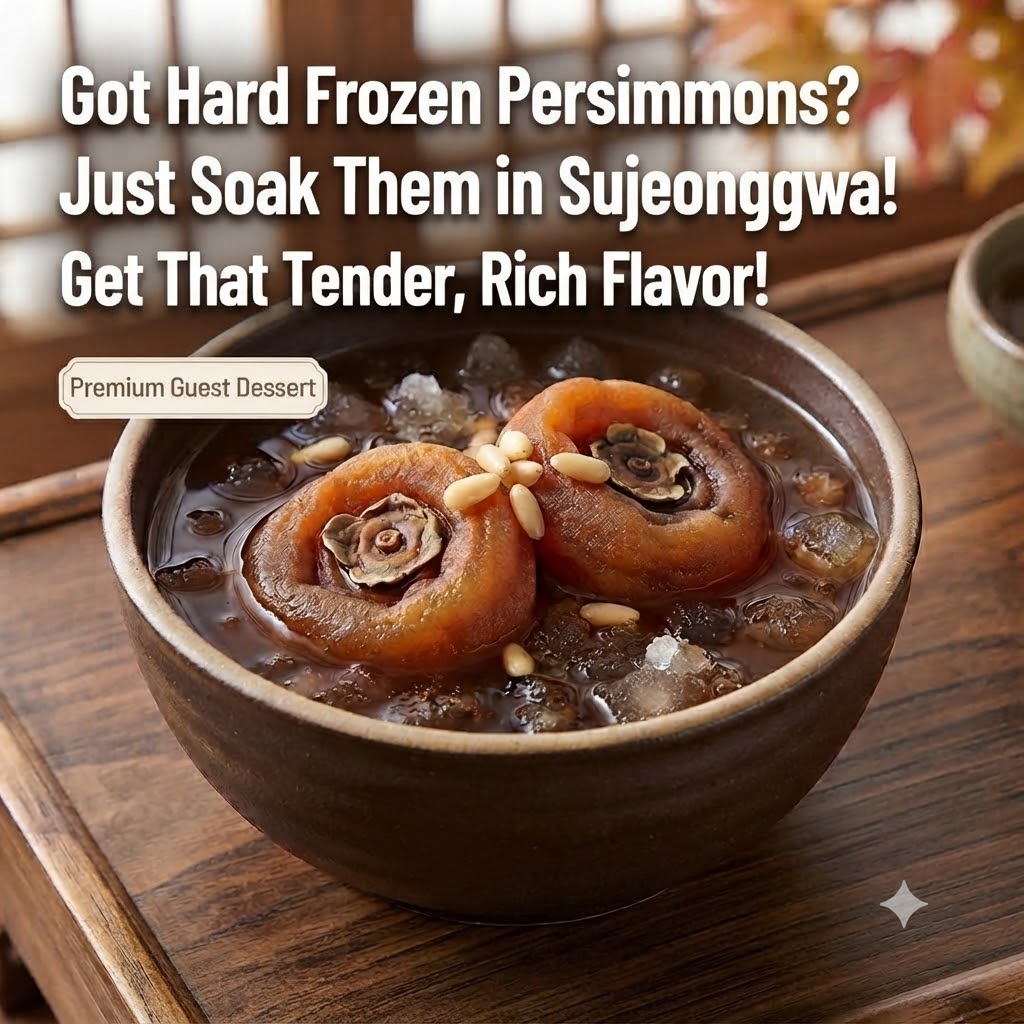
Don't throw away rock-hard frozen dried persimmons! Soak them in Sujeonggwa for a day and they'll become as soft as semi-dried persimmons
Sujeonggwa is a traditional Korean beverage that comes to mind from autumn through winter.
However, there is an unexpectedly fascinating trick when making it.
Instead of just eating dried persimmons that have become too hard in the freezer, submerge them completely in Sujeonggwa for a day or more.
Amazingly, the hard dried persimmons absorb the punch, becoming much softer and taking on a moist, chewy texture just like semi-dried persimmons (banshi).
Plus, the natural sweetness of the persimmons seeps into the punch, making the overall flavor much deeper.
This method has been passed down as a traditional technique, particularly used in northern regions of Korea
by households preparing special drinks to welcome honored guests or elders.
Rock-hard frozen dried persimmons → Remove the stems → Submerge completely in Sujeonggwa → Age in the refrigerator for a day or more → Enjoy the tender persimmons and deepened punch together
# The images below were created with persimmons retaining their stems for illustrative purposes.
🍊 How to enjoy rock-hard frozen dried persimmons
When you buy dried persimmons in bulk, they are delightfully soft and sweet at first, but storing them in the freezer for a long time often makes them quite hard.
In particular, if the outside is tough and the inside is frozen solid, eating them right away can be a bit challenging.
Instead of just letting them thaw naturally, we recommend trying the Sujeonggwa soaking method.
The process is much simpler than you might think.
- Remove the stems from the frozen dried persimmons.
- Prepare the Sujeonggwa after letting it cool down completely.
- Place the persimmons so they are completely submerged in the punch.
- Cover with a lid and store in the refrigerator for at least a day.
- Take one out to try before serving.
The persimmons, which were initially hard, become remarkably tender as they soak up the punch.
In particular, the chewy yet moist texture combined with the signature cinnamon and ginger aromas of Sujeonggwa offers a completely unique experience compared to eating plain dried persimmons.
✨ Why do dried persimmons soften when soaked in Sujeonggwa?
Dried persimmons are a dehydrated fruit with very little moisture left.
This is why prolonged storage in the freezer makes them feel exceptionally firm.
When you leave them in a liquid-based beverage like Sujeonggwa for a sufficient amount of time, the persimmons absorb the moisture and regain their soft texture.
Since the persimmons must be fully submerged to soften evenly, it is best to use a compact container where both the persimmons and punch fit closely together.
This is different from simply serving Sujeonggwa on the side.
The key is to directly submerge the dried persimmons inside the punch and age them for a day or more.
🍵 Making delicious traditional Sujeonggwa at home
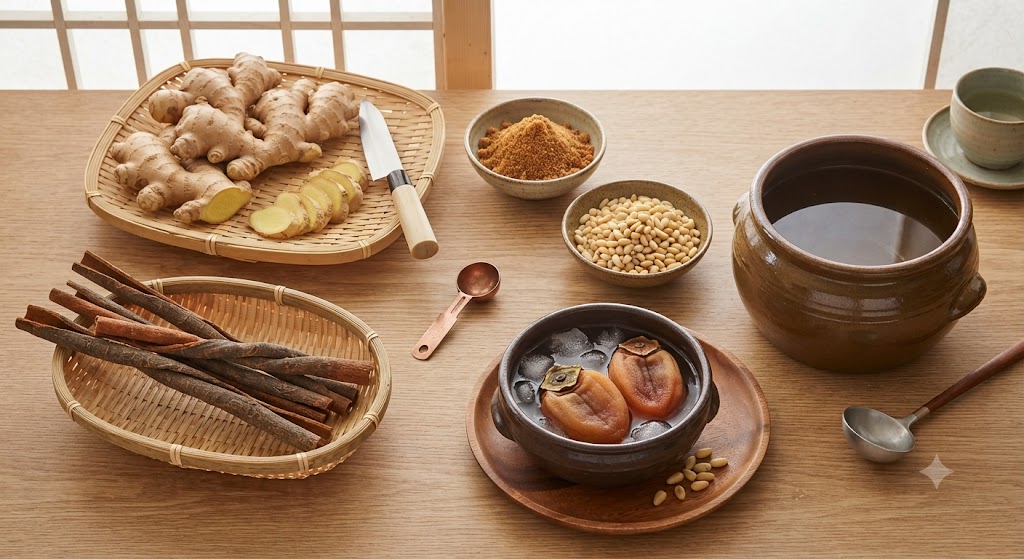
Now it is time to make the Sujeonggwa to soak the persimmons in.
Sujeonggwa is fundamentally a traditional Korean drink made by boiling cinnamon and ginger, sweetening it with sugar or honey, and serving it with dried persimmons.
When making it at home, the flavor profile changes significantly depending on the ratio of cinnamon to ginger.
🛒 Sujeonggwa Ingredients
| Ingredient | Amount | Key Point |
|---|---|---|
| Whole Cinnamon Sticks | 40~50g | Rich and deep cinnamon aroma |
| Ginger | 50~70g | Spicy and warming flavor |
| Water | 2.5~3L | Adjust based on preferred strength |
| Sugar | 180~250g | Adjust to personal taste |
| Dried Persimmons | As needed | Aged by soaking in the punch |
| Pine Nuts | A small amount | Used as a garnish |
🔥 How to Make Sujeonggwa
1️⃣ It is best to boil cinnamon and ginger separately
First, peel the ginger and slice it thinly.
Rinse the whole cinnamon sticks lightly under running water.
Here is an important tip!
Rather than boiling cinnamon and ginger together in the same pot from the start, boil them separately and combine them at the end to easily control each distinct flavor.
Put water and ginger in a pot and boil until the flavor is fully extracted.
In another pot, boil water and cinnamon sticks to extract the rich cinnamon flavor.
Strain both extracts through a fine sieve and combine them into a large pot.
2️⃣ Adjust the sweetness with sugar
Add sugar to the combined cinnamon and ginger extract and stir until dissolved.
At this stage, it is best to aim for a sweetness level that feels slightly less sweet than expected.
This is because natural sweetness will release from the dried persimmons later on.
If your dried persimmons are exceptionally sweet and soft, you can reduce the amount of sugar in the base punch.
Conversely, if the cinnamon and ginger flavors taste a bit too bitter or sharp, feel free to add a little more sweetness.
3️⃣ Let it cool completely before adding the persimmons
Once the Sujeonggwa is ready, let it cool down at room temperature before moving it to the refrigerator.
When adding dried persimmons, make sure the Sujeonggwa is completely cooled rather than hot.
Remove the stems from the dried persimmons and place them into the punch.
Ensure they do not float to the top by using a small container or pressing them down so they are completely submerged in the liquid.
⏰ Changes happen even after just one day
From this point, a little patience is required.
Do not eat them right away after putting them in the fridge.
Leave them for at least a day before taking out a persimmon to taste.
The persimmons, which were previously firm, will become moist and tender as they absorb the punch.
This trick is especially useful if you have dried persimmons that have become overly hard from long-term freezer storage.
Taking a bite of a well-aged persimmon releases subtle notes of cinnamon and ginger, followed by the deep, concentrated sweetness of the fruit.
There is a clear difference in texture between "persimmons simply served alongside Sujeonggwa" and "persimmons aged inside Sujeonggwa for a day."
🥄 The Sujeonggwa itself transforms too
The fun part is that the persimmons aren't the only things that change.
When dried persimmons soak in Sujeonggwa for a long period, their sweetness and unique aroma naturally infuse into the drink as well.
As time passes, the punch develops a smoother, deeper flavor compared to when it was freshly made.
Drop a softened persimmon into a glass of well-chilled Sujeonggwa and top it with a few pine nuts to easily create an upscale traditional dessert right at home.
🍂 Highly recommended for those who:
- Have rock-hard dried persimmons sitting in their freezer
- Find standard dried persimmons too tough to enjoy comfortably
- Love warm cinnamon and ginger aromas during autumn and winter
- Want to make traditional homemade drinks instead of buying sugary commercial beverages
- Wish to present a unique Korean traditional dessert to guests
🌰 Small tips to make Sujeonggwa even more delicious
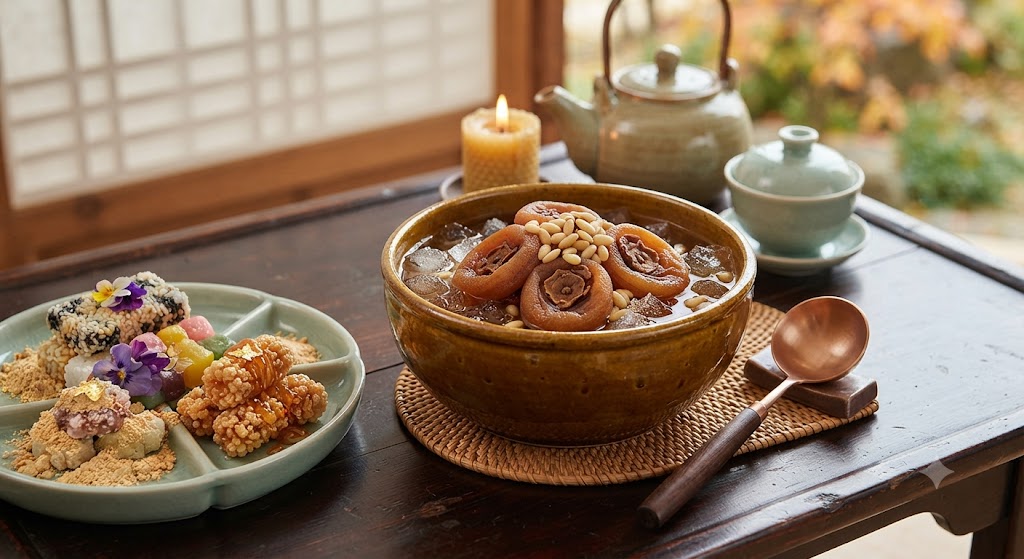
✔ Float pine nuts on top
Floating just a few pine nuts adds a nutty crunch and enhances the visual appeal.
✔ Take out persimmons one by one as needed
Instead of taking out all the persimmons at once, retrieve only what you plan to eat. Leave the remaining ones soaking inside the punch.
✔ Adjust thickness with water instead of ice if too sweet
If the punch feels too concentrated or sweet, add a splash of cold water to balance the strength.
✔ Use whole cinnamon sticks for a clean flavor
Using whole cinnamon sticks rather than powder makes it easier to strain cleanly while achieving a natural color and aroma.
🍁 Why Sujeonggwa tastes even better in Autumn & Winter
Although Sujeonggwa is served cold, it strangely pairs best with the autumn and winter seasons.
Perhaps it is because of the warming comfort provided by cinnamon and ginger?
Add dried persimmons made from autumn-harvested fruits, and you have the ultimate seasonal Korean dessert.
In the past, Sujeonggwa and Sikhe (sweet rice punch) were staples featured on dining tables during holidays and banquets.
While various drinks are easily accessible at cafes nowadays, there are times when a homemade traditional beverage brewed from boiled cinnamon and ginger hits the spot.
Above all, the ability to repurpose rock-hard dried persimmons forgotten in the freezer makes this method especially rewarding.
❄️ Give this a try if you have frozen dried persimmons stored away
There is no need to throw away dried persimmons just because they have turned hard.
Remove the stems, submerge them completely in Sujeonggwa, and let them rest in the fridge for a day or more.
Over time, the persimmons will soak up the punch to become moist and tender, while the punch absorbs the sweet, rich flavor of the fruit.
A single glass of Sujeonggwa and a plump persimmon make for a wonderfully satisfying autumn and winter snack.
🍊 Persimmon Sujeonggwa at a Glance
① Prepare rock-hard dried persimmons from the freezer
② Remove the stems
③ Submerge fully in cooled Sujeonggwa
④ Age in the refrigerator for a day or more
⑤ Enjoy the softened persimmons and deepened punch together
Bought too many dried persimmons this fall?
If you have leftover persimmons tucked away in your freezer, try soaking them in Sujeonggwa instead of eating them as-is.
Opening the refrigerator door the next day to discover how soft the hard persimmons have become is part of the fun.
Top it off with a few pine nuts at the end, and you have completed a classic Korean autumn/winter traditional dessert worthy of serving to honored guests.
※ Storage Tip: Keep the persimmon-infused Sujeonggwa refrigerated and handle it hygienically using clean containers and tongs. Taste and texture may vary depending on the condition of the persimmons and storage environment; discard immediately if any unusual odors or mold are observed.
Related Posts :
The Season of Jujubes: Jujube Latte & Jujube Milkshake | A Taste of Rich Jujube at a Songnisan Cafe
The Season of Jujubes: Jujube Latte & Jujube Milkshake | A Taste of Rich Jujube at a Songnisan Cafe
The Season of Jujubes: Jujube Latte & Jujube Milkshake | A Taste of Rich Jujube at a Songnisan CafeWhen autumn deepens, Boeun in Chungcheongbuk-do naturally comes to mind.While it might not be the first fruit you think of like apples or grapes, when it c
zoomcook.co.kr


