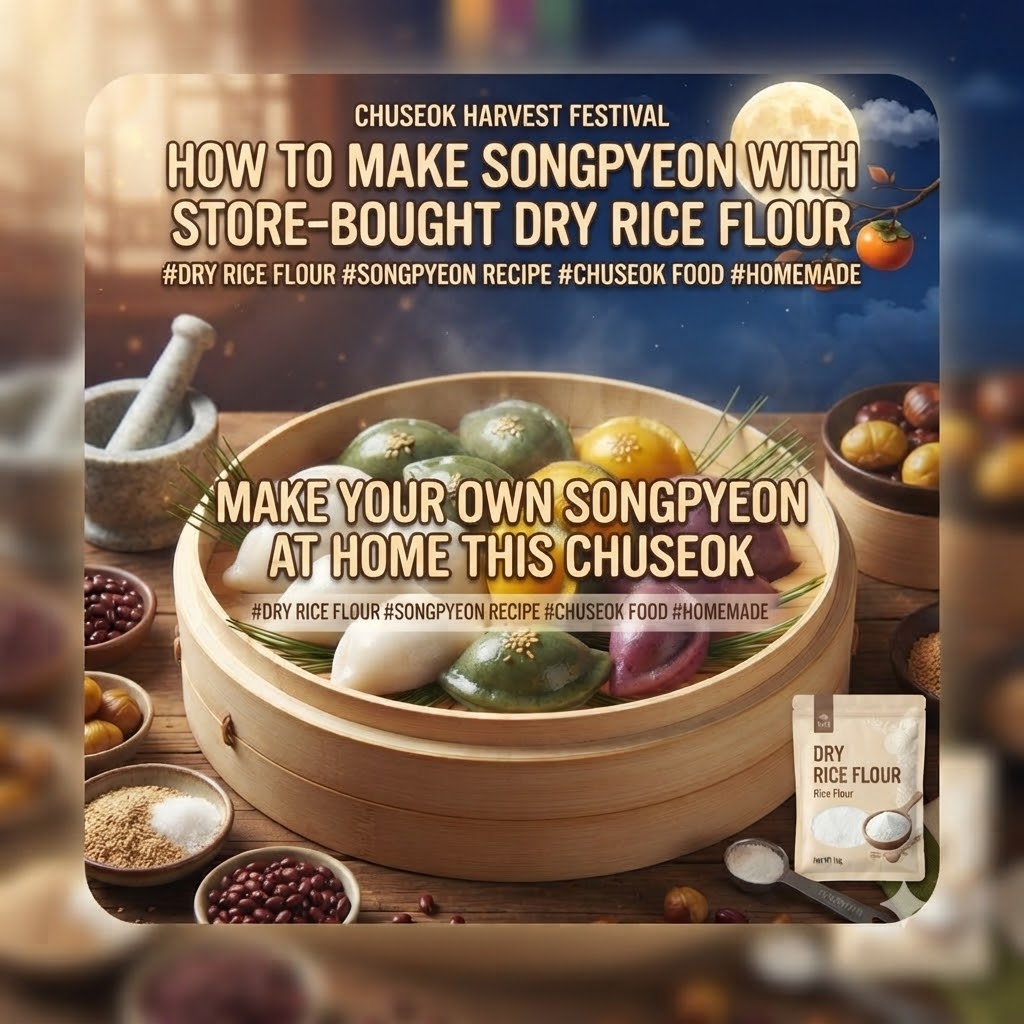
How to Make Songpyeon with Store-Bought Dry Rice Flour | Make Your Own This Chuseok
Whenever Chuseok approaches, I suddenly find myself craving Songpyeon.
When I was young, I just thought of it as a given holiday food, but when I wanted to make it myself, a few questions popped up: “Why on earth is Songpyeon shaped like a half-moon?” and “Can I really make it using dry rice flour from the grocery store?”
To cut to the chase, yes, you can.
Even without wet rice flour freshly milled at a traditional mill, you can easily make Songpyeon using dry non-glutinous rice flour (mepssalgaru) found at any supermarket.
This year, instead of buying store-bought rice cakes, kneading the dough and shaping them one by one with family or children will make a wonderfully fun Chuseok memory.
🌾 What is Songpyeon?
Songpyeon is a traditional Korean rice cake made by scalding non-glutinous rice flour with boiling water, stuffing it with sweet or savory fillings, shaping it into a half-moon, and steaming it. The Encyclopedia of Korean Culture also defines Songpyeon as a steamed rice cake shaped with fillings inside a scalded rice flour dough.
If you want to introduce it in English, it is usually written as Songpyeon, and to foreigners, you can easily explain it as “a Korean half-moon-shaped rice cake traditionally eaten during Chuseok.”
Songpyeon is a traditional Korean rice cake made from rice flour.
It is usually shaped like a half moon and filled with sesame, beans, chestnuts or other fillings. It is one of the most recognizable foods of Chuseok, the Korean harvest festival.
🌕 Why is it Shaped Like a 'Half-Moon'?
At first glance, the shape of Songpyeon might feel a bit unusual. Since it's a major holiday food, you might expect a full, round moon shape, but Songpyeon features a hollow half-moon shape instead.
There are various interpretations behind the half-moon shape of Songpyeon. Because a half-moon grows into a full moon, it is often interpreted as a wish for a better future and abundance. However, since these symbolic interpretations vary slightly by region and tradition, it is best understood as a long-standing traditional symbolism in Korea rather than a rigid rule.
Chuseok is the season of harvest. Because it was a time when families gathered to make food from the crops harvested throughout the year, Songpyeon naturally established itself as a representative holiday food using autumn's new rice and grains.
🌲 Why Does the Name 'Song' (松) Mean Pine?
The Chinese character 松 (pine tree) is used in the name Songpyeon because of the tradition of steaming the rice cakes with pine needles. The Encyclopedia of Korean Culture also refers to Songpyeon with the character 松.
In the past, pine needles were layered in the steamer, and the rice cakes were placed on top. Pine needles prevented the rice cakes from sticking to one another and added a subtle, refreshing pine fragrance to the steamed cakes.
When introducing Songpyeon to foreigners, rather than simply calling it "Korean rice cake,"
Rice flour + filling + half-moon shape + pine needle steaming
explaining these four characteristics together makes it much easier for them to grasp.
🍡 What Are the Different Types of Songpyeon?
Songpyeon is not made identically everywhere. The shape, color, size, and fillings vary depending on the region and family traditions.
| Type | Characteristics |
|---|---|
| White Songpyeon | Clean, savory flavor of plain non-glutinous rice flour |
| Mugwort Songpyeon | Features a green color and herbal aroma from mugwort |
| Sweet Pumpkin Songpyeon | Yellow hue and mild sweetness from sweet pumpkin |
| Purple Sweet Potato Songpyeon | Lovely purple color and visual appeal |
| Ramie Leaf Songpyeon | Regional variety made using ramie leaves |
| Potato Songpyeon | Local variety well-known in regions like Gangwon-do |
The Rural Development Administration's traditional local food records also show recipes using white, yellow, and mugwort-colored doughs filled with chestnuts, green beans, sesame seeds, or red beans.
🥣 Let’s Get Started! Making Songpyeon with Dry Supermarket Rice Flour
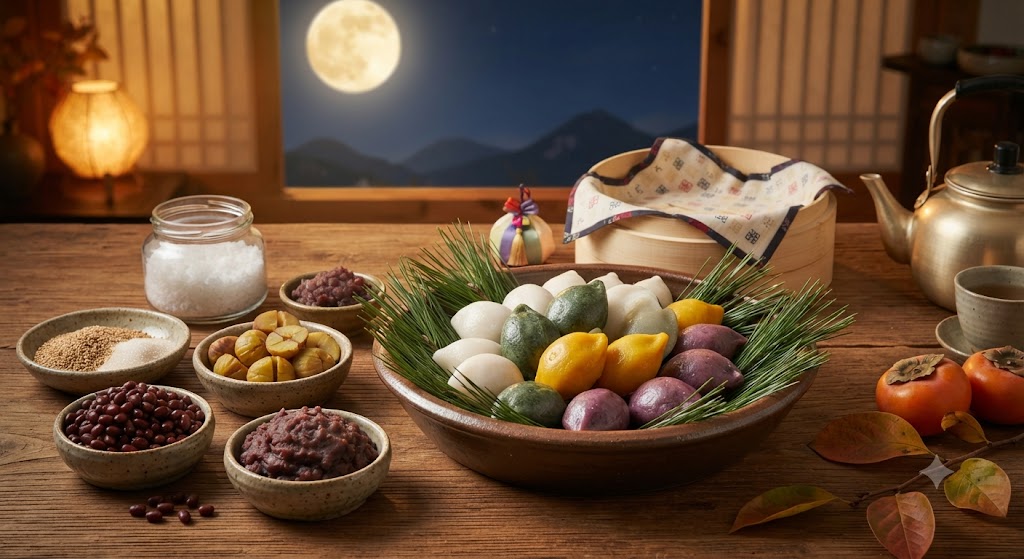
The method I want to recommend today doesn't require hunting down a traditional mill; instead, it uses dry non-glutinous rice flour readily available at grocery stores.
However, there is one crucial thing to keep in mind: you must make sure to buy non-glutinous rice flour (mepssalgaru), not glutinous rice flour (찹쌀가루).
Don't just grab any rice flour package at the store—make sure the label says non-glutinous rice flour (멥쌀가루).
The base dough for Songpyeon requires non-glutinous rice flour.
🛒 Ingredients for Dry Rice Flour Songpyeon
| Ingredient | Quantity | Notes |
|---|---|---|
| Dry Non-Glutinous Rice Flour | 500g | Supermarket product |
| Salt | About 1 tsp | Mix into the flour |
| Boiling Water | Start with ~130-150ml | Adjust depending on the flour brand |
| Sesame Oil | 1-2 tbsp | Brush on after steaming |
| Sesame Seeds, Beans, Chestnuts | To taste | Songpyeon fillings |
🔥 The Secret to Songpyeon Dough: 'Ikbanjuk' (Scalding Method)
This is where beginners make the most mistakes. Do not knead the dough with cold water.
Kneading rice flour by gradually adding boiling water is called ikbanjuk. Seoul Culture Portal's guide on making Songpyeon also instructs mixing dry rice flour with boiling water to scald and knead the dough before shaping.
It's vital not to pour all the water in at once. Even with dry rice flour, the required amount of water can vary based on the particle size and dryness of the specific brand.
① Mix salt into the rice flour.
② Gradually pour in boiling water.
③ Stir with a spatula until it starts clumping, then knead with your hands.
④ If the dough is too crumbly, add a tiny splash of water.
⑤ If it becomes too sticky and wet, add a pinch more rice flour.
⑥ Once the surface is smooth and free of cracks, it's ready!
🤲 How Firm Should the Songpyeon Dough Be?
Songpyeon dough should be neither too firm nor too sticky. When you roll a piece into a ball with your hands, the surface should be smooth, and pressing it lightly shouldn't cause severe cracks around the edges.
Once the dough is ready, cover it with plastic wrap or a damp cloth to keep it from drying out. Because shaping Songpyeon takes time, unused dough left exposed to the air will dry out very quickly.
🥜 What Fillings Should You Use?
① Sesames (The Most Popular)
The most familiar filling, made by mixing ground toasted sesame seeds with sugar. You can easily make it by grinding sesame seeds finely and combining them with sugar. Adding a tiny bit of honey is fine, but too much can cause the filling to leak out while steaming.
② Savory Bean Songpyeon
Using green soybeans or boiled beans offers a savory flavor completely different from sesame fillings. It's a great match for those who dislike overly sweet foods.
③ Chestnut Songpyeon
Finely chopping chestnuts and stuffing them inside creates a nutty, comforting texture with every bite, perfectly capturing the seasonal vibe of Chuseok.
④ Red Bean Paste
Red bean paste is also a classic Songpyeon filling. The Rural Development Administration's traditional food guidelines feature recipes using hulled red bean paste mixed with honey and cinnamon.
🌈 How to Make Colorful Songpyeon at Home
While white Songpyeon is lovely on its own, making colorful, multi-hued Songpyeon adds extra fun for photos during Chuseok.
| Color | Natural Ingredient Example | Vibe/Flavor |
|---|---|---|
| 🟢 Green | Mugwort powder | Herbal and traditional aroma |
| 🟡 Yellow | Sweet pumpkin | Soft texture with subtle sweetness |
| 🟣 Purple | Purple sweet potato | Gorgeous color |
| ⚪ White | Non-glutinous rice flour | Clean and savory taste |
The Rural Development Administration's traditional recipe collection also highlights dividing rice flour and coloring them using boiling water, gardenia seeds, or mugwort.
🌙 Ready to Shape Your Songpyeon?
Pinch off a piece of dough, roll it into a ball in the palm of your hand, and then use your thumb to press a small cavity in the center. Fill it with your choice of sesame, beans, or chestnuts.
If you put in too much filling, it might burst while steaming, so filling it to the point where you think, "Is this too little?" is actually safer and better.
Firmly seal the opening and pinch both ends to form the familiar, pretty half-moon shape.
It's totally fine if your Songpyeon looks a bit asymmetrical.
In fact, homemade family Songpyeon is charming precisely because every piece looks different.
A Songpyeon that doesn't burst is much better than a pretty one that does! 😄
🌲 How to Steam Songpyeon
Add water to your steamer and bring it to a rolling boil to build up plenty of steam. Lay down a cotton cloth or traditional pine needles on the bottom of the steamer rack, and arrange the Songpyeon so they don't touch each other.
Once the water is boiling fiercely and steam is rising, place the Songpyeon inside and steam for about 20 minutes. Seoul Culture Portal's recipe similarly recommends putting them in after the water boils and steaming for roughly 20 minutes.
Take the cooked Songpyeon out, rinse them briefly in cold water, and lightly brush them with sesame oil to prevent them from sticking together and give them a nice glossy sheen.
✨ Did Your Songpyeon Burst? It's Usually Due to One of These Reasons
| Problem | Possible Cause | Solution |
|---|---|---|
| Dough is cracking | Lack of moisture | Add water in tiny increments |
| Songpyeon burst open | Too much filling or poorly sealed edges | Reduce filling and pinch edges tightly closed |
| Songpyeon is too chewy/hard | Insufficient dough moisture or overcooking | Check dough hydration and steaming duration |
| Sticking together | Not cooled properly after steaming | Rinse lightly in cold water and apply sesame oil |
❤️ How to Explain Songpyeon to Foreign Friends
Songpyeon is a traditional Korean rice cake enjoyed during Chuseok, the Korean harvest festival.
It is made from rice flour, filled with ingredients such as sesame seeds, beans or chestnuts, and shaped like a half moon before being steamed. Traditionally, it is steamed with pine needles, which give the rice cakes a subtle pine aroma.
Explaining it this way—sharing details about the Chuseok holiday, the half-moon shape, fillings, and pine needles—rather than just calling it a "Korean rice cake" makes it a wonderful way to introduce Korean culture to foreign friends.
🥰 Why Making It Yourself Makes Songpyeon Extra Special
Looking strictly at its appearance, Songpyeon might not seem like an extraordinary food. But once you make it yourself, the experience completely changes.
Pouring hot water into the rice flour, kneading it, rolling balls by hand, stuffing them with sesame or chestnuts, laughing together by joking, "Is this a steamed bun?" and watching the Songpyeon slowly steam in the pot truly brings out the festive holiday spirit.
Especially if you're making them with children, letting them shape one with their own hands will leave a much longer-lasting memory than just lecturing them on history or origins.
🌕 Skip the Store-Bought Songpyeon and Shape Your Own This Chuseok
Songpyeon doesn't require extravagant ingredients. You can start with just a single bag of dry non-glutinous rice flour from the supermarket.
However, because dry rice flour behaves differently from wet mill flour, gradually adding hot water while tuning the dough texture is key.
① Get dry non-glutinous rice flour from the supermarket
② Add salt
③ Scald and knead with boiling water
④ Cover the dough so it doesn't dry out
⑤ Stuff with desired fillings like sesame, beans, or chestnuts
⑥ Firmly seal into a half-moon shape
⑦ Steam over boiling water for about 20 minutes
⑧ Rinse briefly in cold water and brush with sesame oil
And finally, enjoy eating them together with your family!
🌾 It's totally fine if they look a bit uneven this Chuseok.
The half-moon you crafted with your own hands will become your most memorable Songpyeon. 🌕
📌 Songpyeon Making at a Glance
| Category | Details |
|---|---|
| Main Ingredient | Dry non-glutinous rice flour |
| Dough Preparation | Ikbanjuk (scalding with boiling water) |
| Typical Fillings | Sesame seeds, beans, chestnuts, red beans, etc. |
| Classic Shape | Half-moon shape |
| Steaming Time | About 20 minutes after steam rises |
| Finishing Touch | Quick rinse in cold water followed by sesame oil |
※ Since dry rice flour varies by brand in particle size and moisture content, adjust the water amount gradually within the suggested range. ※ If using pine needles, ensure they are clean, properly washed, and safe for culinary use.
Dry Rice Flour
참미소 국산 쌀가루 1kg 국내산 100% 부침개 호박죽 건식쌀가루 (500g 2봉) - 쌀가루 | 쿠팡
쿠팡에서 참미소 국산 쌀가루 1kg 국내산 100% 부침개 호박죽 건식쌀가루 (500g 2봉) 구매하고 더 많은 혜택을 받으세요! 지금 할인중인 다른 쌀가루 제품도 바로 쿠팡에서 확인할 수 있습니다.
www.coupang.com
이 포스팅은 쿠팡 파트너스 활동의 일환으로, 이에 따른 일정액의 수수료를 제공받습니다.
Related Posts We Recommend :
10 Times Tastier Than Chuseok Pollack Jeon: Red Cod Fillet Pancakes (Hongmegisal Jeon)|Why Once You Try It, It's Hard to Go Ba
10 Times Tastier Than Chuseok Pollack Jeon: Red Cod Fillet Pancakes (Hongmegisal Jeon)|Why Once You Try It, It's Hard to Go Back to Pollack Jeon“Of course, pollack jeon is an absolute must for the holidays!”I used to think that way, too.Every Chuseok
zoomcook.co.kr


