
Foreign Desserts Made Even Better with Korean Ingredients?
7 Autumn Desserts You Must Try in September and October
As September and October roll around, the vibe of American and European desserts shifts away from light summer fruits.
Ingredients that instantly remind us of autumn—like apples, pears, pumpkins, chestnuts, nuts, cinnamon, and maple—start making their appearance.
Then, a fun thought crossed my mind.
To cut to the chase, you don't necessarily need to source every single traditional foreign ingredient.
In fact, using local Korean produce like apples, pears, Korean pumpkins (danhobak), chestnuts, and yuzu lets you create desserts that are wonderfully familiar yet uniquely twisty.
Today, I've rounded up 7 September-October autumn desserts that are easy to find in Korea, have a low failure rate, and offer a fun, unique experience even for foreigners.
🍎 1. American Apple Crisp, Made with Korean Apples?
When talking about American autumn desserts, it's hard to leave out apple pie.
However, trying to bake an apple pie from scratch at home can honestly feel like quite a chore.
You have to make the dough, roll it out, fit it into a pan, cook down the apples, and delicately decorate the top crust.
That's why if you're trying a baked apple dessert at home for the first time, I highly recommend Apple Crisp.
All you have to do is chop up some apples, toss them with sugar and cinnamon, top them with a crunchy mixture of butter and oats, and bake.
Because Korean apples are naturally rich in sweetness and juice depending on the variety, it's best not to overload them with sugar from the start.
If the apples are already sweet enough, cut back on the sugar and try adding just a tiny touch of honey or jocheong (traditional Korean rice syrup).
Tossing in some finely chopped walnuts can also add a delightful, distinctly Korean nutty flavor.
A warm Apple Crisp paired with vanilla ice cream feels effortlessly like something straight out of a cozy café.
💡 A Fun Distinction to Share with Foreign Friends
In the U.S., tart and firm apples like Granny Smith are frequently used for baking.
On the other hand, in Korea, it's very easy to find crisp, sweet varieties like Fuji that are typically eaten fresh on their own.
Therefore, when baking in Korea, it's a great idea to adjust by highlighting the natural sweetness of the apples while cutting down on extra sugar.
🎃 2. Turning American Pumpkin Pie into Korean Danhobak Pie
Once October arrives, pumpkin desserts take center stage across America.
The ultimate classic among them is undoubtedly Pumpkin Pie.
It's a comforting dessert made by blending pumpkin puree with eggs, milk or cream, sugar, and warming spices like cinnamon, then baking it in a pie crust.
But when making a pumpkin pie in Korea, is there really any need to hunt down canned American pumpkin puree?
Korean sweet pumpkin (danhobak) works wonderfully to create an equally delicious and fascinating dessert.
Simply steam the danhobak and mash it up to use as your base.
Because danhobak is naturally quite sweet, add sugar gradually while tasting as you go.
Want to add one more uniquely Korean touch?
I recommend the combination of cinnamon, a hint of ginger, and a very light drizzle of honey.
When the natural sweetness of danhobak meets these warm spices, it creates a surprisingly sophisticated flavor profile.
🌰 3. European Chestnut Desserts, Made with Korean Chestnuts?
When autumn rolls around in Korea, roasted or boiled chestnuts instantly come to mind.
However, chestnuts aren't exclusively a Korean ingredient.
European countries also heavily enjoy various chestnut-based desserts throughout autumn and winter.
Iconic examples include chestnut cream cakes and delicacies like Mont Blanc.
True to its name, a Mont Blanc features chestnut cream piped into thin, spaghetti-like strands designed to mimic the snowy peaks of Mount Blanc in the Alps.
Making this in Korea actually gives you several distinct advantages.
- Perfect for highlighting the rich, savory, and clean taste of chestnuts
- Boiled or steamed chestnuts are readily and easily available everywhere
- Easily adaptable into chestnut paste or chestnut cream
- Makes for a fun storytelling point for foreigners: a 'Korean chestnut dessert'
Foreign visitors in Korea can easily whip up a casual Mont Blanc style treat using just Korean chestnuts, fresh cream, and sponge cake (castella).
You don't need to painstakingly replicate a strict French classic.
Instead, crafting a uniquely local Korean Chestnut Mont Blanc makes the experience much more memorable and fun.
🍐 4. Adding Korean Pears to European Pear Desserts
One thing that consistently surprises foreigners trying a Korean pear for the first time is its distinct character.
Compared to western pears, Korean pears are larger, incredibly juicy, and feature a much more refreshing, crisp crunch.
In Europe, pears are commonly poached in wine with spices or baked directly into tarts.
However, if you're using a Korean pear, it's fun to take a slightly different approach.
Korean pear + cinnamon + honey + walnuts
Slice the pear thinly, lightly pan-sear it, brush it with a touch of honey, and top it with cinnamon and chopped walnuts.
Serve this alongside a scoop of ice cream, and you've got a wonderfully simple, elegant Warm Korean Pear Dessert.
Because Korean pears have such high moisture content, keeping the cooking time relatively short is the key to success.
🍎 5. Giving the French Tarte Tatin a Korean Apple Makeover

Tarte Tatin is one of France's most celebrated apple pastry masterpieces.
It's made by caramelizing apples in butter and sugar, laying pastry dough right over them, baking it, and then flipping it upside down before serving.
The fun part about this dessert is that you don't need to stress over making it look impeccably neat from the start.
The real magic happens when you flip it over to reveal the glossy, caramelized apples underneath.
If you use Korean apples, I recommend scaling back the sugar slightly and letting the natural fragrance and sweetness of the apple shine through.
Adding a light scattering of crushed walnuts or pine nuts can also introduce a subtle, nutty Korean flair.
Hot caramel is extremely dangerous. Please exercise caution to avoid burns, especially if you are baking with children.
🍩 6. Swapping American Apple Cider Donuts for Korean Apple Juice?
This dessert is an absolute blast to introduce to foreign friends.
Apple Cider Donuts are an iconic autumn treat that instantly evokes memories of American apple orchards and harvest season.
They are traditionally made by incorporating apple cider into the batter and finishing them with a coating of cinnamon sugar.
However, finding authentic American-style apple cider in Korea can sometimes be tricky.
What's the solution?
You can easily substitute unsweetened or low-sugar 100% pure apple juice.
Transforming it into a Korean Apple Donut that highlights the vibrant flavor profile of local Korean apples works wonderfully.
Pairing this concept with an autumn trip to a local Korean apple orchard or farming region makes for fantastic content as well.
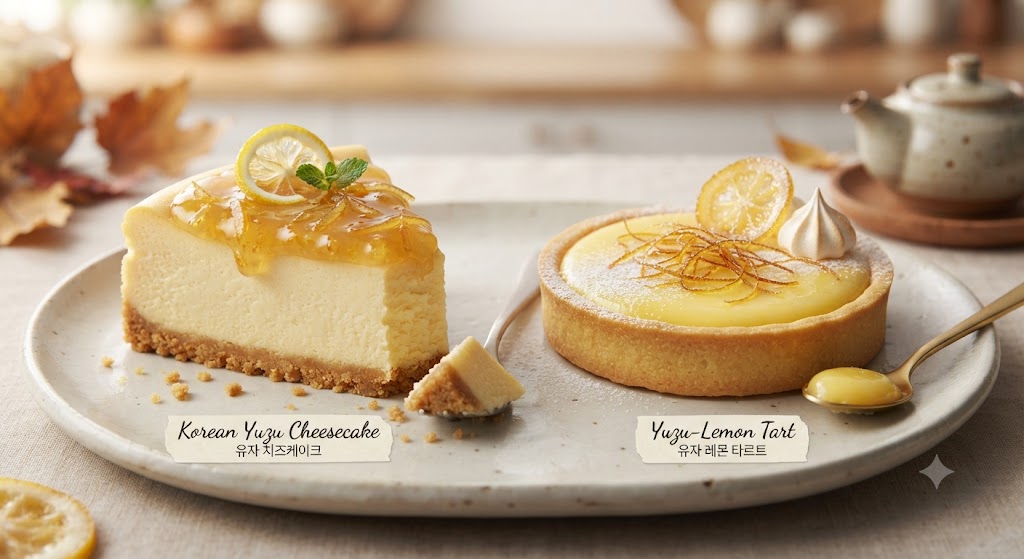
🍋 7. 'Yuzu': A Korean Dessert Ingredient You Must Introduce to Foreigners
Shall we take things one step further and make it even more interesting?
Instead of just adapting Western desserts with Korean ingredients, why not try incorporating uniquely Korean ingredients directly into Western dessert formulas?
One standout example of this is yuzu.
While it shares a refreshing tanginess similar to lemons, its aromatic profile and distinctively bitter-sweet citrus peel flavor are entirely its own.
For instance, you can substitute some of the lemon components in a lemon tart with yuzu, or swirl sweet yuzu tea marmalade (yubacha) straight into a cheesecake.
Yuzu marmalade + cream cheese + heavy cream + cookie crust
→ A simple yet stunning Korean Yuzu Cheesecake
To a foreigner, it looks like a familiar cheesecake, but every bite delivers an unmistakably vibrant Korean aromatic twist.
🇰🇷 Korean Ingredients vs. Western Dessert Ingredients: What's the Difference?
Here lies a point that foreign visitors find genuinely fascinating.
| Easily Available Ingredients in Korea | Common Western Baking Ingredients | Application Ideas |
|---|---|---|
| Korean Apples | Baking Apples | Apple Crisp, Apple Pie |
| Korean Pears | European Pears | Pear Tart, Roasted Pears |
| Danhobak (Sweet Pumpkin) | Pumpkin Puree | Pumpkin Pie |
| Korean Chestnuts | Chestnuts | Mont Blanc |
| Yuzu Marmalade | Lemon & Orange | Cheesecake, Tart |
| Walnuts & Pine Nuts | Pecans & Almonds | Crumble, Tart, Cake |
The fun realization here is that Korea and the West don't actually use completely different categories of ingredients.
We share many common staples like apples, pears, chestnuts, and nuts, but they differ significantly in variety, flavor intensity, and culinary usage.
That's why introducing these Korean ingredients to foreigners allows them to explore something new while still enjoying a comforting, familiar dessert format.
✈️ A Must-Try List for Foreigners Visiting Korea
If a foreign traveler comes to Korea and wants to grab ingredients from a local market or grocery store to bake their own dessert, which ones should they start with?
🥇 Easiest Menu for Beginners
Korean Apple Crisp
Apples + oats + butter + cinnamon + a touch of honey
🥈 For a Truly Unique Korean Flavor
Yuzu Cheesecake
Yuzu marmalade + cream cheese + heavy cream
🥉 To Fully Embrace the Autumn Vibe
Korean Chestnut Mont Blanc
Chestnuts + fresh cream + sponge cake
🍐 For a Healthy & Light Treat
Honey Cinnamon Roasted Korean Pear
Pear + cinnamon + honey + walnuts
🎃 To Celebrate the October Mood
Korean Danhobak Pumpkin Pie
Danhobak + eggs + milk + cinnamon
💡 5 Foolproof Tips for Making Western Desserts with Korean Ingredients
- Scale back the sugar first.
Many Korean fruits are bred primarily for fresh eating, meaning they are naturally packed with plenty of sugar. - Manage moisture levels in juicy ingredients.
Korean pears, in particular, have a high water content, so you'll want to watch out for excess liquid when using them in tarts or cakes. - Add spices gradually.
Spices like cinnamon or nutmeg can easily overpower a dish, so it's best to add them incrementally and taste as you go. - You don't need to follow foreign recipes 100% to the letter.
When your core ingredients differ, it's only natural that the final flavor profile will have its own unique character. - Changing just one Korean ingredient is more than enough.
Rather than trying to overhaul every single component, swapping out just one key element—like the apple, pear, chestnut, or yuzu—is enough to create a brand-new dessert experience.
🍂 September and October Belong to 'Autumn Ingredients'
When you think about it, autumn desserts don't require overly complicated culinary techniques.
Roasting apples, poaching pears, mashing chestnuts, and steaming sweet pumpkins are all it takes to bring incredible desserts to life.
That's precisely why I believe September and October are the absolute best months of the year to try your hand at foreign desserts right at home.
You can recreate American apple crisp using local Korean apples, slide Korean apples into a French Tarte Tatin, or give European chestnut desserts a localized twist with Korean chestnuts.
And why not throw in some uniquely accessible Korean touches like yuzu, jujubes, or pine nuts along the way?
For foreign visitors, it becomes a wonderful gateway to experiencing local Korean agricultural ingredients, while for locals, it offers a fresh, playful way to enjoy familiar everyday apples, pears, chestnuts, and pumpkins.
This autumn, instead of automatically defaulting to a standard apple pie, try starting with a single apple straight from your refrigerator.
The everyday Korean apple you're eating today just might transform into an American-style dessert, or your local Korean chestnuts might turn into a French masterpiece.
❓ Frequently Asked Questions (FAQ)
Q. Can I really make Apple Crisp using Korean apples?
Yes, absolutely. Just keep in mind that if your apples have a naturally high sugar content, you may want to reduce the added sugar accordingly.
Q. Is it okay to use Korean Danhobak for Pumpkin Pie?
Definitely. Just steam the danhobak and mash it down smoothly. Feel free to adjust the amount of milk or cream depending on the moisture level of your pumpkin.
Q. What are the easiest Korean ingredients to introduce to foreigners?
It's best to start with ingredients that have relatively familiar flavors and textures, like apples, pears, chestnuts, and danhobak. From there, introducing distinctive aromatic ingredients like yuzu marmalade makes for an exciting next step.
Q. Do I strictly need to use foreign ingredients when baking foreign desserts?
Not at all. Once you understand the core principles and techniques of a dessert, you can easily adapt it using readily available local ingredients.
※ This post is designed to share creative application ideas for autumn seasonal ingredients and Korean produce rather than generalizing the entire dessert culture of any specific country.
In the next post, I'll be back with a heartfelt, step-by-step guide on how to bake each of these delicious desserts to perfection.
Stay tuned and thanks for reading!
Related Posts You May Also Enjoy:
How to Make Songpyeon with Store-Bought Dry Rice Flour | Make
How to Make Songpyeon with Store-Bought Dry Rice Flour | Make Your Own This Chuseok
How to Make Songpyeon with Store-Bought Dry Rice Flour | Make Your Own This ChuseokWhenever Chuseok approaches, I suddenly find myself craving Songpyeon.When I was young, I just thought of it as a given holiday food, but when I wanted to make it myself,
zoomcook.co.kr


