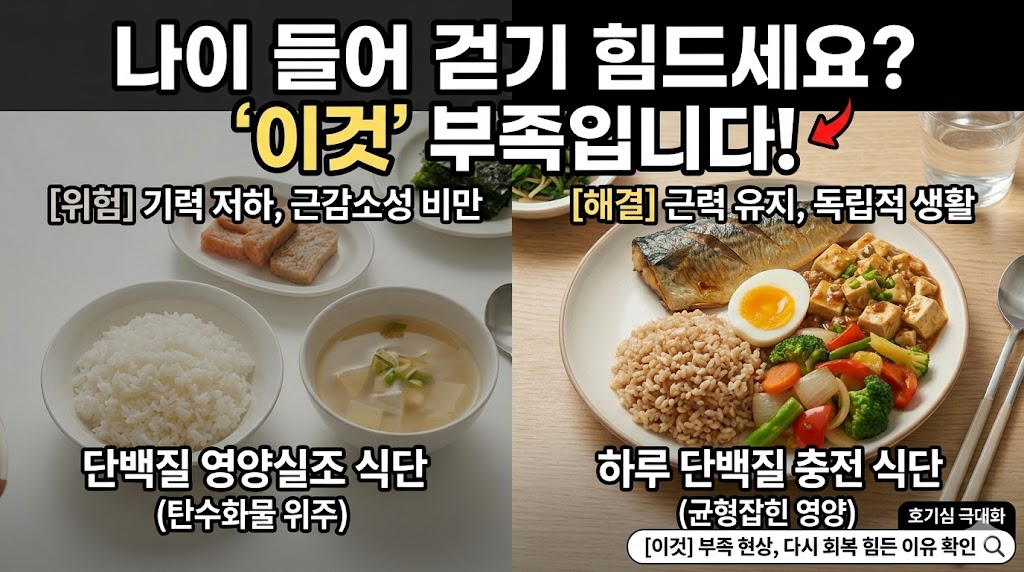
"Even if you don't want to eat, you must eat as you age"... If you lack 'THIS', even walking becomes difficult.
Do you feel out of breath climbing stairs, or find carrying groceries harder than before? Many people just dismiss this as 'aging'. However, this is a very dangerous misconception.
According to research results published in the international academic journal 'Nutrients', deficiency in specific nutrients after age 50 goes beyond simple fatigue and can directly lead to physical functional impairment, making independent daily life impossible. Today, we will deeply analyze the core of elderly health: protein intake and the mechanism of physical breakdown that occurs when it is lacking.
Table of Contents
- 1. After age 50, does protein deficiency make it impossible to walk? (Research Data)
- 2. Where many people go wrong: The difference between 'eating a little' and 'malnutrition'
- 3. The horror of sarcopenia: When is the point of no return?
- 4. [Comparative Analysis] Plant-based vs. Animal-based protein, which is better for the elderly?
- 5. Action Guide: Daily Protein Intake Strategy
- 6. Expert Q&A and Conclusion
If you are reading this, it might be the golden time to check your own or your parents' diet.
I am writing this because my mother recently experienced walking difficulties due to malnutrition, and I learned more about it.
She had lost her appetite and wasn't eating much, but...
It was a shock to be diagnosed with malnutrition at the hospital when her walking became difficult.
If you don't make a change right now, your quality of life in 5 years will be completely different.
Please check the clear evidence below on why you need to take care of 'THIS' right now.
1. After age 50, does protein deficiency make it impossible to walk? (Research Data)
The health 'indicator' for old age is not just body weight. It is 'muscle mass and strength'. A large-scale study recently published in the international journal 'Nutrients' by Professor Rizwan Qaisar's team at the University of Sharjah (UAE) sends us a very strong warning.
The team tracked and analyzed the health data of 38,073 adults over 50 in 27 European countries from 2019 to 2022. The core of the study is the correlation between 'protein intake frequency' and 'physical performance'.
| Group Classification | Risk of Muscle Weakness (Men) | Risk of Physical Functional Disability (Women) |
|---|---|---|
| 50~65 years old | 39% increase | More than double (bathroom use, etc.) |
| 66+ years old | 35% increase | 65% increase (daily activities like grocery shopping) |
These figures are not just statistics. People in the 'low protein intake' group (bottom 10%) struggled to even walk 100m, and showed high disability rates in simple motions like raising their arms above their heads.
In particular, women showed a significant decline in the ability to kneel or bend forward, which is a direct cause of falls in the elderly.
2. Where many people go wrong: The difference between 'eating a little' and 'malnutrition'
Many elderly people say, "I never skip a meal." However, the reality is that it is often just their own perception, and most are experiencing dietary imbalance due to picky eating. 'Meal frequency' and 'protein intake' are separate issues.
When analyzing the diets of elderly people with severe nutritional imbalances, they often have plenty of carbohydrate-based meals (rice, bread, noodles), but their intake of protein (milk, eggs, fish, lean meat), the 'bricks' that make up muscles, is often less than half of the recommended amount. This is called 'protein malnutrition'.
(* Especially in old age, dental problems, decreased saliva production, or reduced ability to taste and digest can lead to nutritional imbalance.)
- Carbohydrate-heavy diet: Raises blood sugar rapidly, causing metabolic diseases without increasing muscle mass.
- Sufficient protein diet: Compensates for the decreased ability to synthesize muscle protein due to aging, delaying the progression of 'sarcopenia'.
If protein intake is insufficient, our body destroys itself. This is because it extracts the energy it needs from muscles. Eventually, you reach a state of 'sarcopenic obesity' where arms and legs become thin and only the belly protrudes, and from this point, walking begins to become painful.
※ This content is based on the latest 2026 health trends and academic research data.
3. The horror of sarcopenia: When is the point of no return?
Sarcopenia progresses slowly, so it is difficult to notice at first.
However, if you suddenly experience 'collapsing', it is highly likely that more than 30% of your muscle has already been lost.
Muscle naturally decreases by 1-2% every year starting at age 50, and if nutrition is cut off during this time, the rate of loss speeds up by more than 2 times.
In particular, women experience a steeper rise in muscle loss speed than men due to hormonal changes after menopause.
The 'point of no return' emphasized by the research team is the state where functional muscle reserve is exhausted, i.e., the point where you are afraid to get up or go grocery shopping on your own. At this stage, muscle recovery is slow with just eating food, and if professional rehabilitation and diet management are not combined, it leads directly to hospitalization and dependency on care.
4. [Comparative Analysis] Plant-based vs. Animal-based protein, which is better for the elderly?
Many people think of 'meat' when they hear protein, or conversely, insist only on 'beans'. Here, a conflict of choice occurs. Which one is more efficient?
| Classification | Animal Protein (Eggs, Fish, Lean Meat) | Plant Protein (Beans, Tofu, Nuts) |
|---|---|---|
| Pros | Rich in essential amino acids (leucine), high absorption rate | Includes dietary fiber and antioxidants, good for vascular health |
| Cons | Concerns about saturated fat and cholesterol | Lack of some essential amino acids, relatively lower absorption rate |
| Conclusion | Muscle synthesis speed is overwhelming | Advantageous for long-term metabolic health |
Realistic Success Criteria: If you want to maintain muscle strength, you must mix the two.
A 'protein hybrid diet', which induces rapid muscle synthesis with animal protein and protects vascular health with plant protein, is the most successful dietary strategy for the elderly.
Conflict zone of success and failure: "You will fail if you do this"
The common mistake of those who fail is 'binge-eating protein'.
There is a limit to how much muscle can be synthesized at once. Rather than eating 100g of meat in one meal, eating 30g divided into three meals is 3 times more efficient for muscle creation. From today, check your diet based on 'Do I include protein in every meal?' This is the key to maintaining your walking ability for 10 more years.
5. Action Guide: Daily Protein Intake Strategy
You understand the theory, but are you overwhelmed by the idea of changing your diet? While a protein intake of 1.2g to 1.5g per 1kg of body weight is recommended, calculating it every time is difficult. Try applying this 'simple actionable guide' by level right now.
| Level | Strategy | Action |
|---|---|---|
| Beginner | Add 'one spoonful' of protein | Add 1 egg to soup or stew, add half a block of tofu to every meal. |
| Intermediate | 'Distributed intake' of protein | Divide into Breakfast (Soy milk+Boiled egg), Lunch (Grilled fish), Dinner (80g lean meat). |
| Advanced | 'Balance' protein | Maintain a 60% Animal : 40% Plant ratio. Consume yogurt and nuts as snacks. |
Most efficient cooking method for the elderly (considering digestion)
As we age, stomach acid secretion decreases, making it difficult to digest meat. Since grilling meat makes it tough and hard to chew, use the following methods:
- Low-temperature cooking: Boiling or steaming gently in water softens the texture and speeds up digestion and absorption.
- Finely mincing: Minced meat in the form of meatballs or patties can significantly reduce the burden on the digestive system.
- Natural tenderizing: When cooking meat, use natural tenderizers like pear or pineapple to make the texture much softer.
Conflict Resolution: "Is meat better or protein powder?" I get this question a lot. Realistically, 'natural food' comes first. However, if you lack appetite or cannot consume regular food, using health functional foods (protein drinks, etc.) as supplements is a hundred times better than nutritional deficiency. If your meal intake has dropped to 70% or less of what it used to be, don't hesitate and get a protein drink immediately.
6. Expert Q&A and Conclusion
Q1. Is it okay to eat a lot of meat if I'm worried about gout or hyperlipidemia?
A. This is a concern for many. However, when sarcopenia occurs, metabolic rate drops, actually worsening blood sugar and lipid levels. If you consume 'lean meat' excluding the fat and choose cooking methods like steaming or boiling, you can protect your muscle mass while minimizing the risk of disease. If meat is burdensome, it is good to alternate between fish and tofu.
Q2. Can I just do walking exercises without supplementing protein?
A. This is one of the biggest misconceptions. If you only walk without the 'raw material' called protein, the body breaks down muscle to use as energy. The 'paradox of exercise' occurs where muscle is lost even faster. You must consume quality protein before and after exercise for muscle regeneration.
Conclusion: "The meal you eat today determines your walking ability 10 years from now"
Health in old age is not luck. Each bean and egg on your table determines your walking ability.
Protein deficiency is not just hunger; it is a signal that your body's engine is stopping.
Open your refrigerator right now. Is there quality protein (tofu, fish, or lean meat) on your dinner table today? If not, you need to adjust your diet plan right now. If you want to walk and stay active freely for the next 5, 10 years, you must accept protein intake as 'essential', not a 'choice'. Your small actions today will completely change your life in old age.
[Practice this right now!] Change the order of your meal from this evening. Just by eating protein food first before carbohydrates, you can increase the digestion and absorption rate.
Recommended posts:
People who will go to the hospital vs. people who will travel after 60... It splits at the table
People who will go to the hospital vs. people who will travel after 60... It splits at the table
The difference between 'lying in bed' and 'traveling' after 60... 10 dietary habits to increase healthy life expectancy by 10 years.
zoomcook.co.kr


