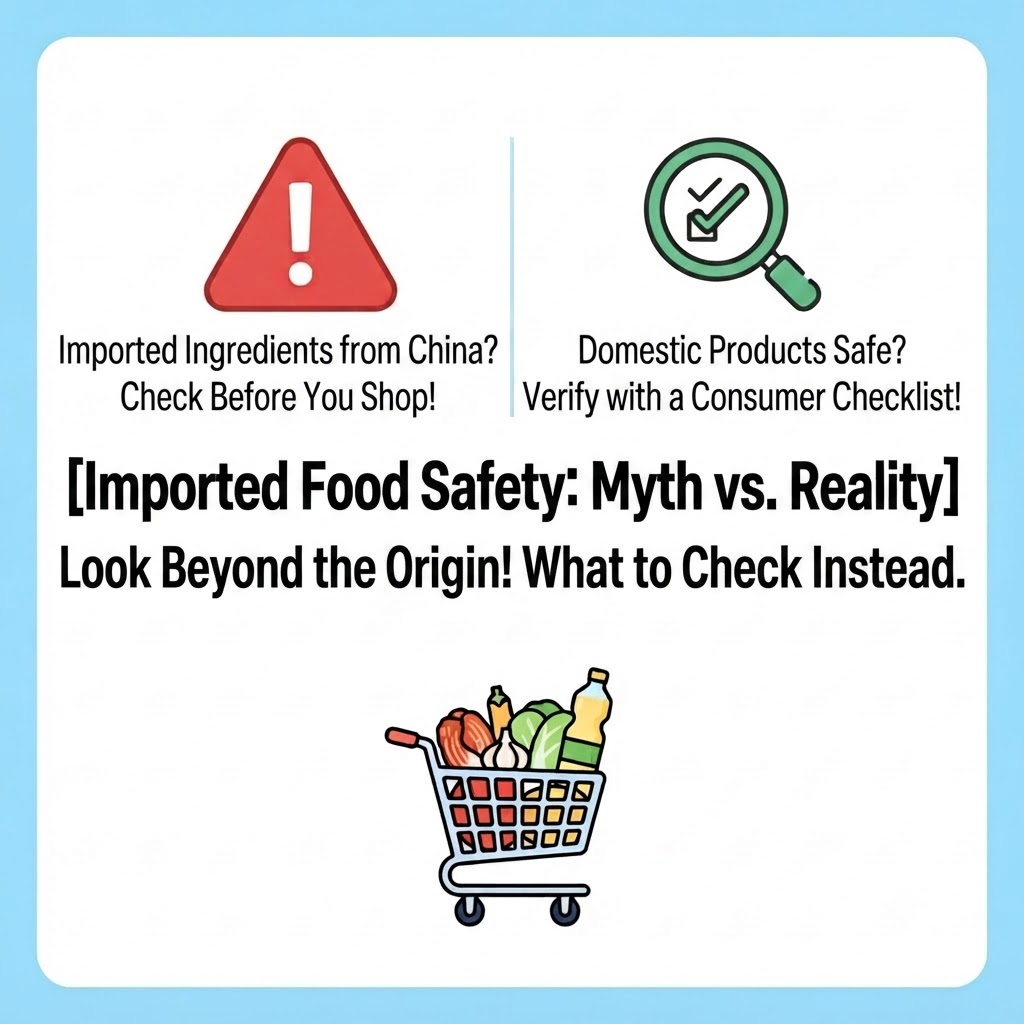
Are Chinese Ingredients Really Okay?
From Food Safety Incidents to What You Must Check When Grocery Shopping
While grocery shopping, we've all probably wondered at least once:
“These are made in China—is it safe to eat them?”
It is especially easy to toss items into our carts without checking their origin when they heavily rely on Chinese raw ingredients, such as kimchi, red pepper powder, garlic, ginger, green onions, mushrooms, frozen vegetables, and seafood.
Lately, safety controversies surrounding Chinese cabbage and kimchi have amplified consumer anxiety. However, what matters most here is not simply jumping to the conclusion that “it’s dangerous just because it’s Chinese.” Instead, we need to examine what actual issues occurred, how South Korea currently inspects imports, and what consumers should check for themselves.
There is no basis to label all Chinese food products as universally dangerous. However, because imported foods from any country—including China—can potentially run into issues during production, processing, storage, and transportation, making a habit of checking country of origin, manufacturing and import info, and recall notices is crucial.
🚨 The Recent Chinese Cabbage Controversy: What Did the Inspection Results Show?
In August 2026, overseas hazard information surfaced indicating that formaldehyde had been used on cabbages grown in Zhangjiakou, Hebei Province, China, sparking widespread anxiety in South Korea regarding Chinese cabbage and kimchi.
In response, South Korea's Ministry of Food and Drug Safety (MFDS) ramped up inspections on Chinese cabbage. Formaldehyde tests were conducted on Chinese cabbages at the customs clearance stage, and the inspections were further expanded to cover Chinese cabbages, salted cabbage, and pre-made kimchi currently distributed within the domestic market.
🔎 Latest MFDS Inspection Results
| Inspection Target | Inspection Result |
|---|---|
| Chinese Cabbages, Salted Cabbage & Kimchi | All 82 tested samples tested negative for formaldehyde |
| Chinese Kimchi Manufacturers for Export | Investigated raw material cabbage sourcing channels of domestic exporters |
| Overseas Manufacturing Facilities | Since October 2024, imported kimchi is restricted to products from HACCP-certified overseas facilities only |
In other words, applying internet rumors claiming that “formaldehyde was detected in Chinese kimchi” across-the-board to all Chinese kimchi circulating domestically does not align with the facts.
Rather, what consumers should focus on in this case is that whenever questionable overseas hazard intelligence emerges, South Korea strengthens its oversight at both customs clearance and domestic distribution stages.
Why Do Chinese Food Ingredients Keep Stirring Up Controversy?
Because China is a global agricultural and food production powerhouse, the variety of food items entering South Korea is massive. Benefiting from high price competitiveness, Chinese raw materials are utilized across a wide range of sectors, including kimchi ingredients, red pepper powder, garlic, ginger, onions, mushrooms, frozen vegetables, seafood, spices, and processed foods.
The core issue lies less in the nationality of a specific country and more in the long journey food takes from production to reaching a consumer's plate.
| Vulnerable Stages for Safety Issues | Potential Problems |
|---|---|
| Cultivation | Pesticide residues, heavy metals, etc. |
| Harvesting & Washing | Microbial contamination, foreign objects |
| Processing | Additive misuse, hygiene management issues |
| Transportation | Temperature control failures, cross-contamination |
| Storage | Mold growth, spoilage, microbial proliferation |
| Cooking | Inadequate heating, cross-contamination |
Therefore, it is much more accurate to view these as management checkpoints required for all imported foods, rather than issues unique to Chinese foodstuffs.
⚠️ There Have Indeed Been Severe Food Accidents Resulting in Fatalities in China
This does not mean that food safety issues within China are merely online myths. In reality, some extremely severe food-related accidents have occurred there.
① The 2020 Jidong County Incident: 9 Fatalities in Heilongjiang
A prime example is the incident that took place in Jidong County, Heilongjiang Province, China, back in 2020. Several family members suffered mass poisoning after consuming suantangzi (a fermented corn-based product), leading to the tragic deaths of all nine people who ate it.
Investigations revealed the presence of bongkrekic acid in the food. This is a lethal toxin produced by specific bacteria capable of causing catastrophic damage to vital organs like the liver and kidneys.
This incident was not simply caused by eating “Chinese ingredients.” It is critical to distinguish it as a food poisoning case triggered by consuming food where toxins developed during improper fermentation and storage.
Research analyzing foodborne bongkrekic acid poisoning in China documented 19 mass outbreaks between 2010 and 2020, resulting in 146 infections/poisonings and 43 deaths. Homemade fermented corn products, certain rice noodles, and mushroom varieties were identified as the root culprits in several of these cases.
② The 2025 Lead Contamination Incident at a Chinese Kindergarten
An even more shocking incident occurred in 2025 in Tianshui City, Gansu Province, China. It was discovered that a kindergarten had intentionally used industrial paint—unfit for human consumption—in food preparation solely to make the meals look more visually appealing.
Reports revealed that out of 251 children tested during the investigation, abnormal blood lead levels were confirmed in 233 children, with 201 requiring hospitalization.
This case sent shockwaves through the public because it wasn't a matter of residual pesticides, but rather the deliberate use of banned, toxic substances in food.
Food safety goes far beyond raw ingredients.
Who processed it, in what kind of facility, and using what methods and storage conditions matter immensely.
🛢️ Even Cooking Oil Transport Tanks Became a Controversy in China
In 2024, a major controversy erupted in China concerning the transportation of cooking oil. Investigative reports by Chinese media revealed that tanker trucks hauling industrial liquids or fuel were being repurposed to transport edible oil without undergoing proper cleaning.
This scandal grew large enough to prompt official investigations by Chinese authorities and severely shook consumer confidence in food safety within China.
The critical takeaway here is not just that “Chinese cooking oil is dangerous,” but rather the reality that food safety is deeply interconnected with the entire distribution, transportation, and storage infrastructure.
🍽️ However, Stories Claiming "People Died From Eating at Chinese Restaurants" Require Caution
Online platforms often circulate stories framed as “people dying after eating restaurant food in China.” However, such claims require verification of exact locations and root causes.
Looking at actual research on foodborne illnesses in China, while group food poisoning cases have occurred in restaurants and food service operations, not all fatalities happened at restaurants. Data from China's 2000s and 2010s foodborne disease reports show that while many patients fell ill at restaurants and cafeterias, a higher proportion of fatalities occurred from food prepared in home kitchens.
Furthermore, food poisoning incidents from Chinese restaurants overseas sometimes get misreported as incidents originating in mainland China. Therefore, you should not jump to the conclusion that Chinese ingredients themselves are fatal simply based on a headline stating "people died after eating at a Chinese restaurant."
① Did the incident happen in mainland China?
② Was it restaurant food or home-cooked food?
③ Was the root cause the ingredient itself or the cooking/storage process?
④ What specific substances or pathogens were confirmed through actual laboratory testing?
🛒 So, How Should We Approach Grocery Shopping?
In reality, the most practical approach for consumers is straightforward. Rather than blindly adopting a policy of “avoid Chinese goods at all costs,” a much more sensible stance is “check origins and product details, and exercise extra diligence with high-risk foods.”
1️⃣ Check the Back of the Package Before the Front
When picking out groceries at the supermarket, avoid relying solely on marketing copy or product names. Instead, build a habit of checking the ingredient list, country of origin, manufacturer, importer, and expiration date on the back.
Even if a product is labeled “Made in Korea” or “Domestic Manufacture,” it does not automatically mean every single raw ingredient is locally sourced.
For instance, a kimchi manufactured domestically may source its cabbage, red pepper powder, and garlic from different regions. Hence, you need to distinguish between the 'country of manufacture' and the 'origin of raw ingredients.'
2️⃣ Pay Special Attention to Red Pepper Powder, Garlic, Ginger, and Sesame Seeds
Because spices and seasoning ingredients used frequently at home are kept and consumed over long periods, checking their origin is vital.
| Food Item | What to Check When Purchasing |
|---|---|
| Red Pepper Powder | Pepper origin, production/expiration dates, seal integrity |
| Garlic & Ginger | Origin, presence of mold, discoloration, or softness |
| Dried Mushrooms | Origin, moisture levels, mold, off-odors |
| Frozen Vegetables | Packaging damage, freezing state, origin |
| Kimchi | Origin of primary ingredients like cabbage and red pepper powder |
| Seafood | Origin, refrigerated/frozen condition, packaging state |
3️⃣ Ask Yourself "Why Is It This Cheap?" If a Price Seems Too Low
Low price tags do not inherently mean a product is unsafe. China's massive production scale naturally allows for cheaper goods compared to domestic alternatives.
However, if a product is nearing its expiration date, severely worn out in packaging, or lacks verifiable distribution channels, you should refrain from buying it solely based on price.
• Severely bloated or damaged packaging
• Frozen goods that show signs of thawing and refreezing
• Items showing mold, unusual odors, or discoloration
• Products with unclear origin or missing importer information
• Items past or difficult to verify for expiration dates
• Products from unknown or unverified sellers
📱 How to Check Directly via Food Safety Korea
In truth, this is the best method. Rather than relying on internet rumors stating “toxic substances were found in XYZ Chinese product,” checking official food safety information managed by the government is the most accurate approach.
Food Safety Korea allows you to search for recalled/suspended foods, domestic foods, imported foods, and corporate profiles.
In particular, the Imported Food Information Portal lets you look up non-compliance records and inspection details for imported items, enabling you to search product records even after making a purchase.
Check Origin → Check Ingredients → Check Manufacturer/Importer → Check Expiration Date & Package Condition → Search Recall & Non-Compliance Info on Food Safety Korea if Needed
Should You Completely Avoid Chinese Food Products?
Personally, I believe that adopting a blanket mindset that “everything Chinese is dangerous” is not a sound approach to food selection.
During the recent Chinese cabbage controversy, actual inspection results showed that 82 batches of Chinese cabbage, salted cabbage, and pre-made kimchi distributed in South Korea tested completely negative for formaldehyde.
On the other hand, inside China, past incidents like bongkrekic acid poisonings caused real fatalities, and the 2025 kindergarten incident involved lead-infused paint used in meals.
Ultimately, what we need to evaluate is the specific product and its management process, not just a single country's label.
| Flawed Judgment | A More Rational Approach |
|---|---|
| Made in China = Automatically Dangerous | Verify Origin, Inspections, Distribution, and Product Condition |
| Made in Korea = Automatically Safe | Verify Storage, Cooking, and Distribution Processes Even for Local Goods |
| Trusting Online Posts Blindly | Verify Government Inspection Records and Recall Notices |
⚠️ Especially at Restaurants, Relying Solely on 'Origin Labels' Is Insufficient
When eating out at restaurants, consumers cannot directly inspect the manufacturing and storage conditions of raw ingredients.
Therefore, rather than fixating on whether a dish contains Chinese ingredients, factors like whether refrigeration/freezing was managed properly, whether food was thoroughly cooked, whether cooking utensils are clean, and whether cross-contamination occurred between raw and ready-to-eat foods are critical for preventing actual food poisoning.
Studies investigating food safety incidents frequently point to food contamination, improper processing, and cross-contamination as core culprits.
(However, during periods of heightened concern, minimizing dining out and preparing meals at home is something I personally recommend.)
• Refrigerated foods left sitting out at room temperature for too long
• Pests buzzing around food display areas
• Excessively unhygienic cooking stations
• Using the same utensils for raw meat and ready-to-eat dishes
• Food emitting an unusual odor or taste
→ It is safest not to eat it, even if you waste money.
💡 Ultimately, the Most Crucial Habit for Consumers Is 'Checking Info Over Origin'
Anxiety regarding Chinese food ingredients is understandable, given that some historical food safety incidents inside China were indeed grave.
Conversely, generalizing that all Chinese food products are hazardous is equally inaccurate. Foods imported into South Korea undergo multiple regulatory steps, including customs inspections and market-level surveillance sampling. Whenever hazard intel arises, oversight on specific items is intensified.
Thus, the most practical approach for consumers is simple:
🛒 5 Golden Rules for Grocery Shopping
① Check the Origin
② Check the Ingredient List
③ Check the Manufacturer & Importer
④ Check the Expiration Date & Package Condition
⑤ Check Recall & Non-Compliance Info on Food Safety Korea
And one more thing: A product isn't good simply because it's cheap, nor is it bad simply because it's made in China.
When it comes to the food going onto our family tables, looking at where it was made, what ingredients it contains, and how it was distributed is a far wiser shopping strategy than looking at origin labels alone.
Furthermore,
as for the best food purchasing approach,
I highly recommend utilizing distribution channels that directly connect local markets
to enjoy fresh, affordable options without middlemen margins.
📌 Food Safety Checklist to Keep Handy
- Check the origin of cabbage and red pepper powder before buying Chinese kimchi
- Inspect dried foods and red pepper powder for moisture and mold
- Check frozen foods for signs of thawing and refreezing
- Verify Korean labeling requirements on imported foods
- Search whether a product has been recalled or pulled from sales
- Exercise caution with online food items of questionable origin
- Discard foods emitting abnormal odors, colors, or tastes
※ This post is an informative content piece designed to outline things consumers should verify when purchasing groceries, based on public food safety data and case studies, rather than claiming that all food from a specific country or brand is unsafe. For the most accurate and up-to-date hazard information and recall statuses regarding food safety, always consult the latest data from the Ministry of Food and Drug Safety and Food Safety Korea at the time of purchase.
Food Safety Korea (Official Website):
https://www.foodsafetykorea.go.kr/?utm_source=chatgpt.com
Imported Food Information Portal:


