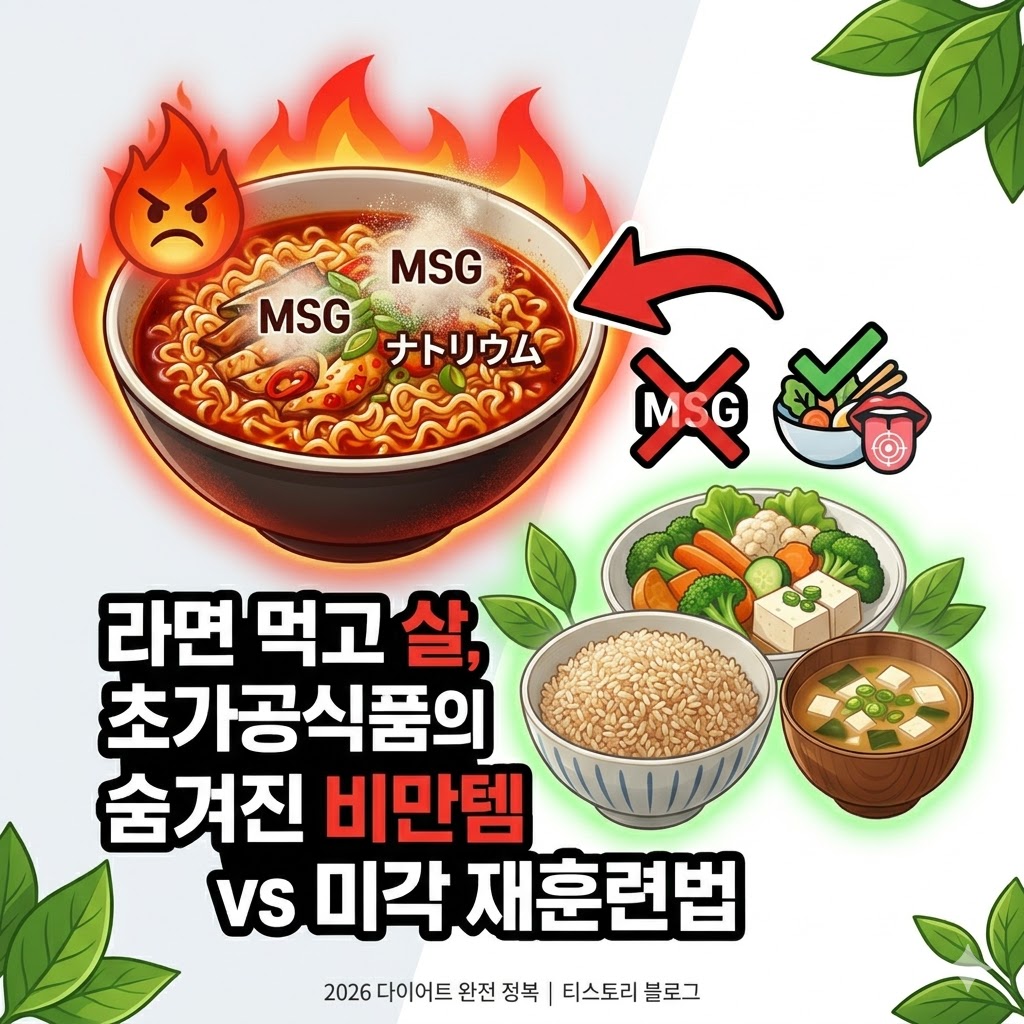
2026 Diet Chronicles: Is MSG Really the Culprit Behind Weight Gain From Ramen? (The Hidden Obesity System of Ultra-Processed Foods vs. Taste Bud Retraining)
"I only had a light bowl of instant ramen for lunch today, so it should be fine, right?"
"Isn't the MSG in ramen broth the main culprit causing water retention and weight gain?"
When people resolve to lose weight, the number one food they cut out is instant ramen. Many point their fingers at MSG (Monosodium Glutamate)—the source of that intense, savory umami flavor—as the root cause of obesity. This stems from a long-standing fear that artificial seasonings ruin your metabolism and turn your body into a weight-gaining machine.
⚠️ This is a major misconception that most people get wrong!
To jump straight to the conclusion: MSG itself contains virtually no calories and is not directly stored in the body as fat. In other words, consuming MSG does not mean it transforms straight into belly fat. Yet, why do numerous nutritionists and diet experts still rank instant ramen as public enemy number one?
A one-dimensional approach like "Ramen is 500 kcal, so I'll just eat less" will only trap you in an endless cycle of diet success and failure. The core issue isn't a single ingredient called MSG; rather, it lies in 'this system' precisely engineered by big food corporations to hijack our brain and taste receptors.
In this article, we uncover the scientific reality of the addictive palate that food companies have researched for decades. Furthermore, we reveal realistic strategies to reset your desensitized taste buds within 2 to 4 weeks, creating a body that naturally sheds weight. Read to the end, and you will face the startling truth that your cravings were never just a matter of willpower.
CONTENTS Key Takeaways
- 1. The Two Faces of MSG: Direct Obesogen vs. Obesity Environment Creator
- 2. The Food Engineering Trap: The Addictive 'Hyper-Palatable' System
- 3. The Onslaught of Ultra-Processed Foods via Real Data (Success vs. Failure Criteria)
- 4. Step-by-Step Taste Bud Retraining Guide (Beginner, Intermediate, Advanced Plans)
- 5. Frequently Asked Questions (Q&A) & Final Summary for Diet Pros
1. The Two Faces of MSG: Direct Obesogen vs. Obesity Environment Creator
We commonly believe that "eating foods high in MSG makes you fat." However, we need to clarify one crucial fact. **"Does MSG directly cause weight gain?"** and **"Does MSG create an environment that triggers obesity?"** are two completely different concepts that must be separated.
From the first perspective, MSG is simply sodium bound to glutamate, an amino acid that forms proteins. MSG itself has near-zero calories, does not accumulate in the body like fat, and does not instantly make you put on pounds. In fact, adding a tiny pinch of MSG to fresh home-cooked vegetables or chicken breast to increase satisfaction and reduce salt (sodium) intake can actually benefit a diet. Modern nutritional science largely rejects the outdated notion that "MSG = Poison."
The real issue stems from the second perspective. Rather than directly storing fat, the intense flavor systems that include MSG completely dismantle a person's eating habits, building an addictive environment that compels them to eat more.
2. The Food Engineering Trap: The Addictive 'Hyper-Palatable' System
For decades, food companies have poured massive capital and research into calculating "flavors that the human brain find nearly impossible to stop eating." Food scientists and obesity researchers call this the 'Hyper-Palatable Food' system.
Typical hyper-palatable food groups that trigger cravings include:
- Instant Noodles & Cup Ramens (Refined Carbs + Deep-Fried Fats + Ultra-High Sodium)
- Potato Chips & Processed Snacks (Saturated Fat + Refined Salt + Flavor Enhancer Combo)
- Fast Food (Burgers, pizza, fried chicken consisting of high-fat and high-carb structures)
- Frozen Meals & Pre-made Sauces (High-Fructose Corn Syrup + MSG + Nucleotide Seasonings)
Evolutionarily, the human brain releases the highest surge of dopamine when [Salty + Sweet + Fatty] flavors hit the palate simultaneously. This is exactly why instant ramen is so dangerous. A close inspection of the nutrition label reveals why we cannot help but drink the broth down to the last drop.
The fundamental reason some whole-food-oriented experts criticize MSG is not because the molecule itself is toxic. It is because the food categories loaded with MSG (ramen, frozen meals, processed meats, heavily seasoned takeout sauces) are ultra-processed items designed to systematically cause overeating.
Consequently, gaining weight from ramen isn't merely about the 500 kcal number on the packet. It is the direct consequence of an ultra-processed seasoning system that completely breaks your brain's satiety sensors.
3. The Onslaught of Ultra-Processed Foods via Real Data (Success vs. Failure Criteria)
The phrase "conditioning your palate" is not just a psychological concept—it is a proven biological phenomenon in modern neuroscience and nutrition. Regularly consuming ultra-processed foods elevates the baseline response of your taste buds and neural pathways, requiring increasingly stronger stimuli to register satisfaction.
💡 Case Study on Taste Bud Adaptation
When hooked on highly stimulating foods, wholesome home-cooked stews, fresh greens, or steamed vegetables taste completely bland or even unappetizing. However, what happens if you intentionally create a 2 to 4-week (14 to 28 days) taste isolation period by cutting out ultra-processed foods?
The subtle, natural sweetness and deep flavors inherent in whole foods begin to come alive again. This explains why people who successfully overhaul their health consistently note: "I used to think I couldn't live without soda or ramen, but after resetting my palate, they taste way too sweet and salty to eat more than a bite." This is grounded in concrete biological adaptation data.
When tracking the root causes of weight gain, most individuals do not fail because of a lack of willpower against pure carbs or fats. Instead, they lose control within the hyper-stimulating sensory environments engineered by ultra-processed foods.
Is your current dietary management on the path to success, or is it trapped in a loop of failure? Evaluate your standing with the realistic metrics and criteria outlined in the checklist below.
If you check two or more items in the 'Risk State' column, you are highly likely to face severe yo-yo effects, no matter how hard you restrict your calories. This isn't because of weak willpower; your neurochemical reward loop is being held hostage by ultra-processed formulations.
How do you break this stubborn loop and transition to sustainable health management? Put down the calorie counter for a moment and look at the actionable 'Taste Bud Retraining Protocol' detailed in the next section.
4. Step-by-Step Taste Bud Retraining Guide (Beginner, Intermediate, Advanced Plans)
Successful health practitioners don't just calculate the metrics of chicken breast and sweet potatoes. Their core focus rests on four pillars: ① Reducing ultra-processed food frequency, ② Lowering extreme flavor profiles, ③ Increasing whole-food ratios, and ④ Retraining taste receptors.
Here is a tailored 4-week reset guide aligned with your current baseline. Instead of punishing fasts, this path methodically restores your palate.
👉 Struggling to cut out deep-rooted cravings for delivery and instant meals?
Instead of fighting food with extreme calorie restriction, starting immediately with the [Beginner Phase: Air-Dried Noodle Swaps & Diluted Sodium Protocols] is a smarter, lifestyle-driven choice that boosts your success rate by over 300%.
5. Frequently Asked Questions (Q&A) & Final Summary for Diet Pros
We have selected and clarified the most common questions and points of confusion regarding instant ramen, MSG, and ultra-processed food diet strategies.
Q1. Are air-dried noodles completely safe from MSG or ultra-processed concerns?
A. They aren't 100% free of concerns, but they make an excellent stepping stone. Because air-dried noodles bypass deep-frying, their fat content and overall calories are drastically lower than standard ramen. However, the soup packet still retains highly concentrated sodium and flavor enhancers (like MSG) that stimulate your palate. Use them as a tactical bridge away from fried varieties during your beginner phase, but remember to ditch the full broth and keep migrating toward whole foods over time.
Q2. Can natural seasonings (like kelp or anchovy powder) still trigger palate addiction?
A. No, natural umami profiles do not override your brain's regulatory mechanisms. The natural umami compounds (such as inosinic and guanylic acids) found in whole anchovies, kelp, or mushrooms are eaten alongside natural fibers and minerals. This ensures a slow, balanced absorption rate that avoids hormonal spikes. Leveraging natural powders to lift the enjoyment of home-cooked dishes is an excellent habit utilized by health experts to bypass processed cravings.
Q3. What should I do if my work environment forces me to eat out or order takeout during my reset phase?
A. Simply switching the 'style of preparation' can shield you from the worst impacts. Steer away from dishes where everything is stewed, mixed, or drenched in sauce (like thick stews, curries, or pre-sauced bowls). Instead, focus on menus where the ingredients keep their original shape and sauces can be pushed to the side (such as grilled fish plates, basic proteins, or hot pots). Halting heavy sauce consumption goes a long way in defending your hypothalamus from desensitization.
🏁 Conclusion: Look Past Simple Numbers and Reform Your Flavor Environment
For far too long, we have been trapped by simplistic calorie formulas like: "Ramen is 500 calories, so a 1-hour walk will wipe it out." Yet the true engine of weight gain isn't the calorie count in a vacuum; it is the ultra-processed additive systems that disrupt our brains, preventing us from putting down the fork even when full.
There is no need to demonize MSG itself and punish yourself with flavorless meals that breed stress. The only variable we truly need to master is our exposure to industrial, hyper-palatable convenience items that systematically dull our internal regulation.
🚀 Ready to Reset Your Plate Today?
Stop beating yourself up over a perceived lack of willpower. By navigating a 2 to 4-week taste retraining path to bring your satiety signaling back online, your body will naturally move toward its ideal equilibrium without exhausting restrictions. We highly recommend exploring wholesome food frameworks and clean seasoning choices to jumpstart your metabolic reset today.
💬 "Wishing you the absolute best on your clean-palate journey.
Explore our related guides today and take your first step toward an energized, lighter version of yourself!"


