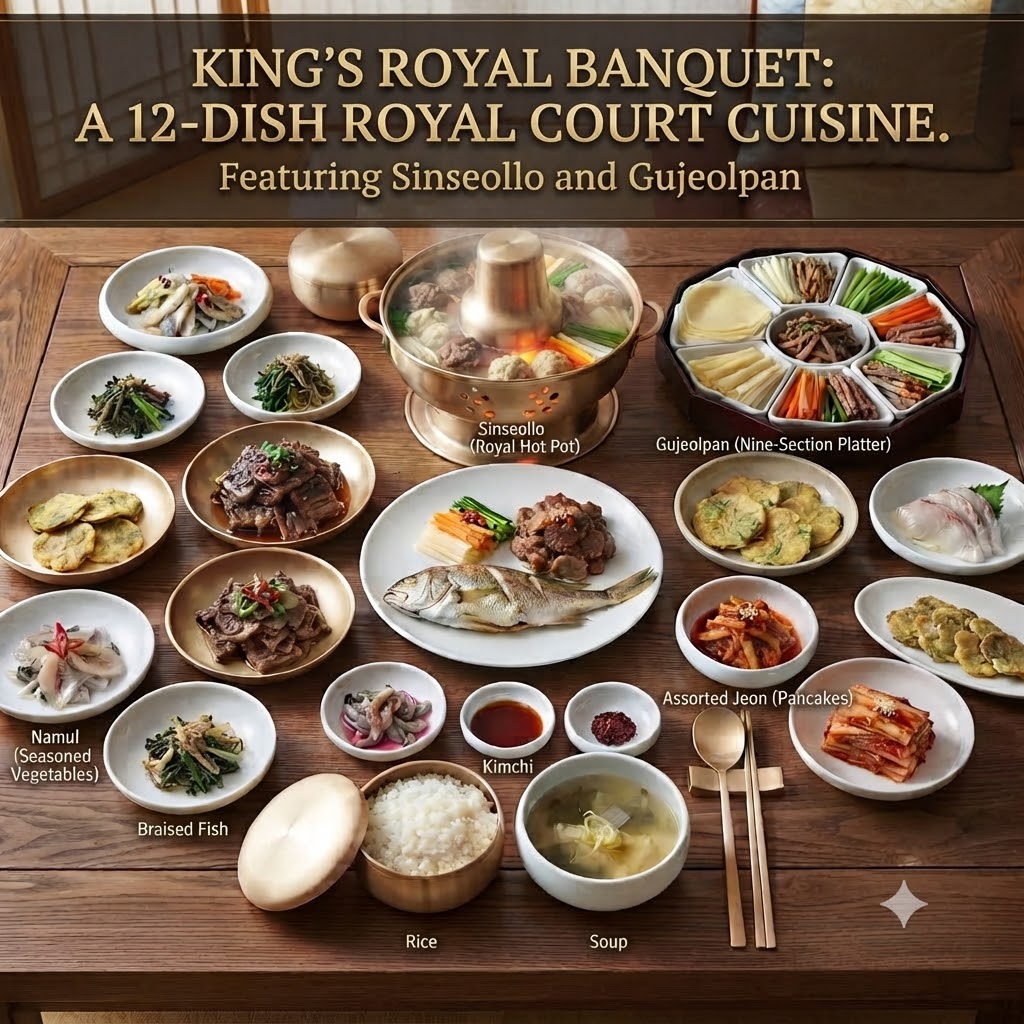
👑 How Did Kings Eat? A Korean Royal Table That Foreigners Find Even More Fascinating
“Did Joseon kings really eat a 12-dish royal meal every single day?”
When foreigners who are new to traditional Korean culture are shown a Joseon king's table, the question they ask before anything else isn't about the food.
“And did the king really eat all of that?”
That's right. If you look at the grand dining tables set up for kings in historical dramas, the scale is truly overwhelming. Rice and soup are placed, surrounded by a dense arrangement of small bowls filled with side dishes like namul, meat, fish, jeon, jjim, jeotgal, and various pastes and sauces.
However, the interesting thing is that if you simply think of a king's table as ‘a table with an absurd amount of side dishes,’ you miss the most important part.
Every single bowl has a purpose, the colors of the food have meaning, and the ingredients served changed depending on the season.
Today, let's take a slightly different look at the dazzling king's table we see in dramas.
🍚 1. First, the Most Famous Number: ‘12-Chup’
Whenever people talk about Joseon kings, the 12-chup bansang is bound to come up.
Yet, this is where many people misunderstand.
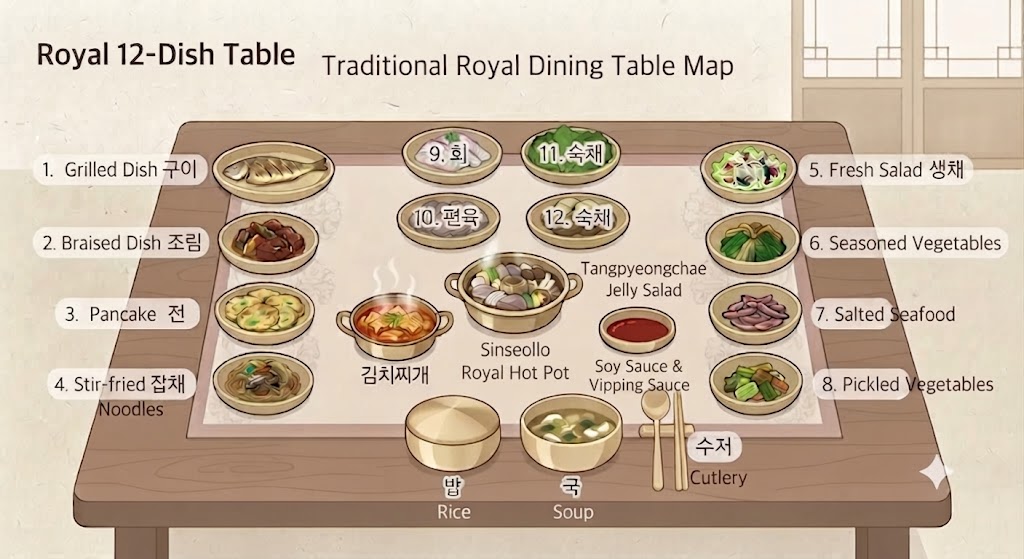
→ No.
The term ‘chup’ refers to counting the number of side dishes served, excluding staples like rice, soup, and stews.
Therefore, calling it a 12-chup table doesn't simply mean there are 12 items on the table, but rather a traditional style of formal dining featuring a rich variety of side dishes.
Furthermore, it is also a misconception to think that just because he was a king, he ate the exact same 12 dishes every day.
The composition of the food changed depending on the season, available ingredients, the king's health condition, and the dining context.
The real question is: What kind of food was actually served on a king's table?
🥩 2. “Since He Was a King, Did He Only Eat Rare Meats Every Day?”
This is probably what most people imagine first.
However, if you look at traditional royal cuisine, vegetables and namul actually hold a surprisingly prominent presence.
While ingredients like beef, chicken, and fish were used, a wide variety of ingredients such as greens, vegetables, mushrooms, tofu, and various pastes and sauces were utilized together.
This is what makes traditional Korean dining so fascinating.
Rather than focusing on serving one large, dominant meat dish, a culinary tradition developed where various ingredients are prepared in small portions and harmoniously arranged together on a single table.
Namul & greens
Beef, chicken, etc.
Fish, salted seafood, etc.
Thus, a king's table was closer to harmoniously composing a variety of ingredients rather than just ‘eating a lot of luxury ingredients.’
🥢 3. What Foreigners Find Most Fascinating: Not the Food, But the ‘Bowls’
It is always fun to ask foreigners who are seeing a traditional Korean table for the first time:
“What is the most fascinating thing?”
In many cases, they are drawn not just to the food, but to the sight of multiple small bowls neatly arranged together.
In traditional Korean dining, a distinct culture developed where rice, soup, and side dishes are all served in separate, individual bowls.
As a result, a multitude of bowls naturally fill the dining table.
In the royal court especially, various types of tableware were used depending on the kind of food and its purpose.
✨ An Interesting Point Here
Rather than dumping all the food onto a single plate, Koreans developed a culinary culture where every dish is given its own designated place.
Therefore, having many small bowls doesn't simply mean using lots of dishes, but means enjoying the distinct flavor and form of each individual food item.
🥣 4. What is the Secret of the Gleaming Golden Bowls?
If you look at modern reenactments of a king's table, certain bowls immediately catch your eye.
They are heavy, golden-hued vessels.
These are yugi, the famous traditional Korean brassware.
Yugi is a traditional metal tableware made by alloying copper and tin, characterized by its uniquely warm, golden glow.
If you are a foreigner seeing them for the first time, you might mistake them for solid gold.
However, the charm of these bowls goes beyond just their color.
The solid weight you feel when picking them up and the sturdy texture unique to metal are also essential features of traditional tableware.
“It looks like gold, but it's actually traditional Korean brassware.”
⚪ 5. Yet, ‘White Bowls’ Were Just as Important in the Royal Court
If you only think of golden brassware, you might assume royal tableware was overwhelmingly flashy, but white porcelain also played a vital role during the Joseon Dynasty.
Joseon white porcelain exudes a calm, understated elegance rather than excessive, flashy ornamentation.
Imagine what happens when red meat, green namul, and yellow egg garnish are placed inside a pristine white bowl.
Instead of competing for attention, the bowl serves as a quiet backdrop that lets the natural colors of the food truly pop.
This is one of the unique aesthetic charms found in traditional Korean table settings.
Flashy food + understated bowls
Even by modern standards, this combination creates a remarkably sophisticated visual.
🌈 6. A King's Table Had ‘Color,’ Not Just Flavor
If you look at traditional Korean food, the colors are strikingly vibrant for a reason.
Green namul, yellow egg, white tofu, red chili peppers, brown meats, and mushrooms……
When placed on a single table, these elements naturally weave together a palette of multiple colors.
A prime example of this is gujeolpan.
True to its name, gujeolpan features various ingredients separated into nine compartments around a central dish, meant to be wrapped and eaten inside thin wheat crêpes.
Instead of mixing everything together all at once, diners get to pick and choose their preferred ingredients to wrap themselves.
So, thinking about it from a modern perspective, you could describe it as a ‘traditional Korean DIY wrap.’
When you introduce gujeolpan to foreigners, they are instantly hooked not just by the taste, but by the curiosity of “How do you eat this?”
And once they try wrapping it themselves, it becomes a genuinely fun experience.
🌿 7. Even the King Ate ‘Seasonal Food’
Nowadays, we can easily eat strawberries in the winter and enjoy a wide variety of vegetables all summer long.
However, during the Joseon Dynasty, refrigerators didn't exist.
Because of this, what you could eat and when you could eat it mattered immensely.
Spring brought wild greens, summer offered seasonal vegetables, autumn provided harvested grains and fruits, and winter relied heavily on preserved foods.
This is precisely why culinary techniques for long-term storage—such as kimchi, fermented pastes, and dried vegetables—flourished.
Wild greens
Seasonal vegetables
Grains & fruits
Preserved foods
In short, a king's table was never detached from the natural world.
Instead, the shifting changes of the seasons flowed straight onto the dining table.
🍯 8. Is the Meal Over After the Main Course? Traditional Korean Desserts
Surprisingly, the dessert culture of royal dining offers a delightful twist.
Korea has a long history of diverse traditional desserts such as tteok, hangwa, yakgwa, and dasik.
Dasik, in particular, is made by pressing grain or nut flour mixed into small carved molds.
Though small in size, they feature intricate patterns that showcase immense craftsmanship at a glance.
Pairing these with traditional beverages like sikhye or sujeonggwa brings a graceful conclusion to the meal.
This atmosphere is completely different from the heavy, overly sweet cakes and ice creams we enjoy today.
Small yet intricate, sweet without being overwhelming.
This is another subtle charm of traditional Korean desserts.
🤔 9. Did the King Really Eat All of That Food?
Here, we need to clear up one major misconception.
The royal tables recreated in modern historical dramas and tourism content are visually magnificent.
However, seeing them should never lead you to believe that “the king ate all of this food in one sitting every single day.”
The concept of ‘12-chup’ is meant to explain the structural format of the table setting and the count of side dishes, not to imply the king polished off every single identical dish daily.
What matters more is that a diverse array of dishes was presented on a single table, with each item serving a distinct culinary purpose.
👑 In Short
A king's table was closer to a ‘well-curated table’ rather than a ‘pig-out feast.’
10. The Legacy of the Royal Table Still Lives in Modern Korean Meals
The fascinating thing is that these traditions didn't end inside the royal palace.
Even today, when we order a meal at a Korean restaurant, rice and soup arrive accompanied by kimchi, namul, jangajji, and a spread of various side dishes.
To a foreigner's eyes, this culture is quite extraordinary.
When a main dish is ordered, they might wonder, “Why do the dishes keep coming out?”
For Koreans, however, it is so deeply familiar that it feels entirely natural.
And therein lies the charm.
The everyday Korean meal you experience today
still preserves ancient Korean culinary heritage.
👑 Ultimately, the Most Fascinating Part of a King's Table Isn't the ‘Dish Count’
At first glance, a king's table catches your eye with the mere number of side dishes.
Once you look closer, however, the story changes entirely.
The small bowls reflect a deliberate separation of flavors, the golden brassware embodies the history of traditional tableware, and the white porcelain captures the quiet artistic sensibility of Joseon.
Green namul, red dishes, and yellow egg garnishes achieve a harmonious balance of color, while seasonal ingredients reveal a lifestyle lived in tune with nature.
And all of these elements come together on a single table.
🍚 A single meal was a piece of history in itself.
If you only see food, it's cooking;
when you see the bowls, ingredients, and seasons together, it becomes culture.
So, the next time you walk into a Korean restaurant and see a scatter of small side-dish bowls, try looking at them through a different lens.
“Why are they giving me so many side dishes?” instead of,
“Ah, Koreans have been enjoying this variety of flavors all on one table since ancient times.”
Think about it this way.
Who knows? The everyday Korean meal you experience today might quietly preserve a culinary heritage passed down from the royal tables of a very distant past.
Recommended Posts :
The Nutritional Value of Seasonal Lotus Seeds & Healthy Recipes with Lotus Root, Leaves, and Seeds
The Nutritional Value of Seasonal Lotus Seeds & Healthy Recipes with Lotus Root, Leaves, and Seeds
🌿 The Nutritional Value of Seasonal Lotus Seeds & Healthy Recipes with Lotus Root, Leaves, and SeedsAs summer fades and autumn approaches, lotus flowers start to wither and lotus seed pods begin to ripen across ponds. While lotus root is commonly enjoye
zoomcook.co.kr


